What is change management?


Why change management?
Change is taking place in your organization every day with new projects and initiatives to improve performance, increase profits, and enhance your competitive advantage. You could be implementing technology to enable a more workforce, re-engineering a process to ensure regulatory compliance, or pursuing an enterprise-wide transformation around customer experience. In all of these changes, people are the common denominator for achieving intended outcomes—which is why you need change management.
Change management strategy
Here is the plan for or systematic approach to dealing with a transition or transformation in your organization. A change management strategy describes specific ways in which an organization addresses change in goals, processes or technology related to parts of the business, such as the scheduling management.
The goal of establishing an effective change management strategy is to minimize negative effects of change and to keep project scope in check. To institute a change management strategy, key stakeholders must create a plan for how to do the following:
✧ Recognize when a change is needed.
✧ Approve changes.
✧ Implement changes.
✧ Monitor changes to ensure they delivered the desired effect.

Why does change fail?
Organizational outcomes are the collective result of individual change, you can measure results across three interdependent levels. These are:

Change management methodology
The ADKAR® Model is a key framework within the Methodology, designed to facilitate successful organizational change by focusing on individual transformation. The ADKAR Model emphasizes five critical outcomes necessary for effective change: Awareness, Desire, Knowledge, Ability, and Reinforcement. The ADKAR Model zeroes in on guiding individuals through change, addressing potential roadblocks and resistance. By equipping leaders with strategies and tools to engage employees effectively, the model ensures that organizational changes succeed by aligning individual behaviors and outcomes with the broader goals of the change initiative.
The ADKAR Strategy is a globally respected methodology that works well in supporting digital transformations and effectively brings together the technical and people needs. The ADKAR Model of Change Management is a focused, outcome-oriented change management method that aims to limit resistance to organizational change.

Change management approach


 Sustain
 Planning Approach | Assess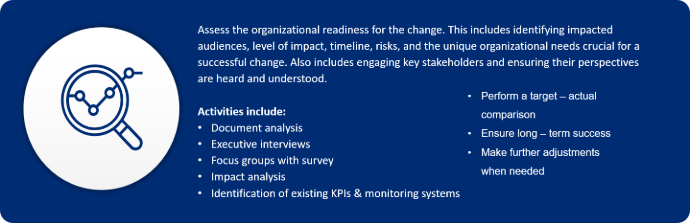
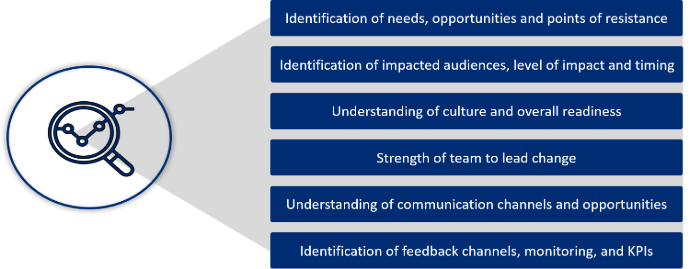
Take Change Readiness Survey
Planning Approach | Design
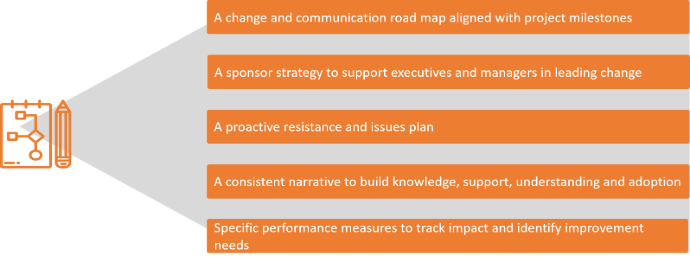
Planning Approach | Implement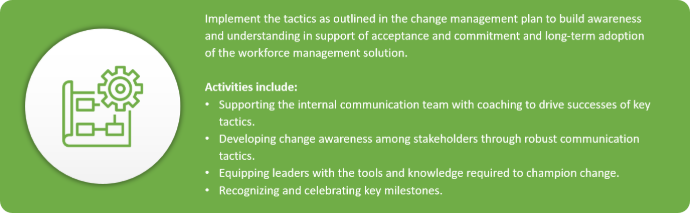
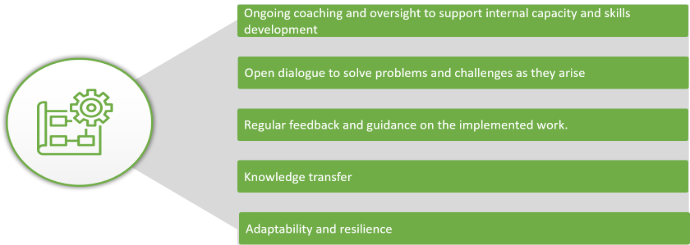
Planning Approach | Sustain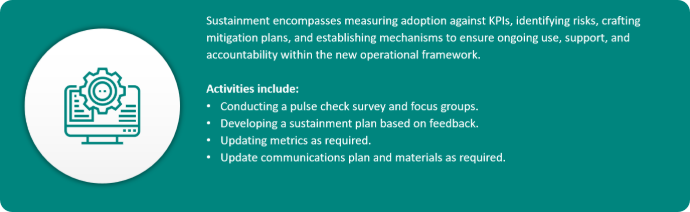

Take Sustainment Survey
Change management ROI
With change management we can capture and drive the amount of project benefits dependent on adoption and usage. By quantifying the people-side benefit contribution, we can calculate the change management return on investment (ROI), providing content for meaningful and enlightening conversations with project leaders and executives to build buy-in and commitment to change management.
As we begin to rethink and reposition the ROI of change management by making the direct connection to project results, we must make a shift in conversation.
The ROI of change management is the additional value created by a project due to employee adoption and usage. The process below empowers you to capture and express a quantified value for change management's contribution.
When we divide the net benefits (benefits - costs) by the project costs, we calculate the value captured by undertaking the effort. Project leaders and senior leaders are comfortable and familiar with this sort of analysis.
The other branch of expected project benefits includes those that are in the category of "Dependent on adoption and usage." Suppose our new software program not only has lower maintenance and license fees (the independent benefits), but if it is used proficiently by employees, it produces more accurate and timely data, increasing performance and reducing errors. Those additional benefits result from impacted employees adopting and using the new system effectively.
The amount of project benefits that are dependent on adoption and usage is what we can capture/ensure/drive/realize through change management.


